
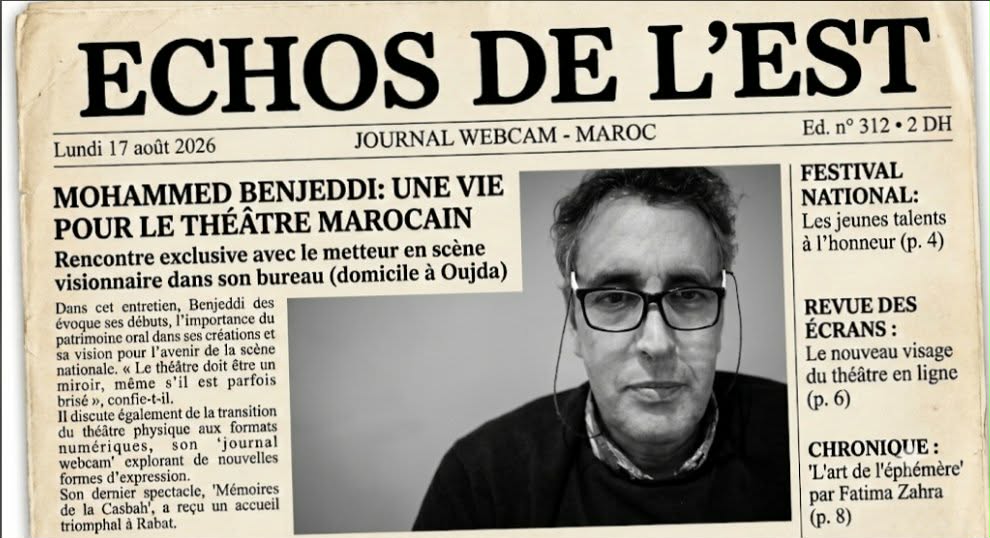
Moroccan Amateur Theatre Today: A Memory That Will Never Die
ECHOES FROM THE EAST
Webcam Journal - Interview with Mohammed BENJEDDI – Artistic Director of International Festivals in Morocco and Moroccan Theatre Practitioner Oujda, August 2026
Author: Mohammed Benjeddi
FITAS – Agadir
AITA/IATA Associate Member 374, Morocco
Date of publication: 13/11/2026
STATEMENT OF INTENT
This interview was born out of a long connection with Moroccan amateur theatre and a conviction: one cannot speak of today’s theatre without questioning the memory of those who live it, defend it, and continue to build it.
The meeting took place in Oujda, while Mohammed Benjeddi was preparing the schedules and upcoming deadlines for international festivals. This is not about a man looking back at the past, but about a man continuously committed to theatrical activity, looking toward the future through the lens of his experience.
Through this exchange, several questions are raised: What makes theatre truly alive? What place should be given to the audience? What role do the artist, the State, and institutions play? What is the relationship between creation and subsidies? Between festivals and permanent theatrical life? Between heritage and modernity? Between academic training and stage experience?
The memory of Jerada (his hometown) naturally emerges in the dialogue—not as nostalgia, but as a starting point to understand a core conviction: theatre can be born anywhere, even in places with modest resources, as long as there is passion and a desire to connect. The interview is also a tribute to amateur theatre, to its generations of artists, its small venues, its volunteers, its difficulties, and its quiet struggles. Ultimately, it defends a simple idea:
A hall is not enough. A festival is not enough. A subsidy is not enough. A school is not enough. There must be a lasting encounter between the artist and the public. Because theatre remains, above all, a human presence, a shared word, and a memory in the making. And as long as an actor can walk into an empty space, face a few spectators, and speak a true line, theatre will never be permanently defeated.
THE INTERVIEW
Med Benjeddi is seated near his computer. His phone rings regularly. A message arrives from Europe—a troupe is waiting for an invitation, another file needs to be checked. Between two phone calls, he consults a program, corrects a date, replies to mail. Amidst all this activity, The Journalist initiates the conversation. He does not meet a man turned toward the past, but a man constantly immersed in the present of theatre, attentive to its evolution and concerned about its future.
The Journalist: Med, I meet you in the middle of preparations for the upcoming international festivals. Between invitations, foreign troupes, programming, and all this organization, do you still have time to reflect on Moroccan theatre itself?
Med Benjeddi: Precisely—it is while preparing festivals that I reflect most on theatre. When you receive troupes from different countries, when you discover their ways of working, their concerns, and their relationship with the audience, you are naturally led to look at your own theatre with different eyes. A festival is not just a succession of shows. It is also a mirror. And sometimes, that mirror forces us to ask ourselves questions.
The Journalist: What questions are you asking yourself today?
Med Benjeddi: The first one is very simple: Where do we stand? We have talented artists, training schools, numerous festivals, very active associations, and a genuine desire to create. But I sometimes wonder if we have managed to build, alongside all of this, a true theatrical life.
The Journalist: What do you mean by a “true theatrical life”?
Med Benjeddi: A theatrical life cannot be reduced to the number of festivals organized in a year, nor to the number of performances presented. Theatre must become part of citizens’ habits. When someone knows that in Oujda, Rabat, Meknes, or another city, they can regularly go to the theatre, meet artists, discover performances, and gather with an audience, then we can speak of theatrical life. Otherwise, we risk multiplying events without building true continuity.
The Journalist: You are making an important distinction between a festival and theatrical life.
Med Benjeddi: Yes. A festival is a moment of encounter. Theatrical life is a permanent presence. I love festivals. I have dedicated a large part of my energy to them, and I continue to prepare them with passion. They allow artists to meet, audiences to discover other cultures, and cities to open up to the world. But a festival must never become a substitute for everyday theatre.
The Journalist: Yet, the public turns out in large numbers during certain festivals.
Med Benjeddi: That’s true. But we must ask ourselves what happens when the festival lights go down. Does the audience come back the following week? Is there a troupe rehearsing in the city? A hall that programs regularly? Young people who know where to go to see a show? That is where, in my opinion, the true theatrical health of a city is measured.
The Journalist: You speak with high expectations. Is it the experience of several decades in theatre that makes you so attentive to these issues?
Med Benjeddi: Perhaps. But I do not look at theatre with nostalgia. I look at it with concern sometimes, with enthusiasm often, and above all with the desire to see it continue living. I started very young in Jerada. I experienced amateur theatre, its difficulties, its enthusiasm, its small venues, its big dreams. Today, conditions have changed, resources have evolved, and technologies have disrupted our relationship with culture. But one thing has not changed: for theatre to exist, there must be a meeting between someone who has something to say and someone who agrees to listen.
The Journalist: And do you feel this meeting is threatened today?
Med Benjeddi: It is certainly harder to build. But I wouldn’t say it is threatened with extinction. Theatre has always had to fight to exist. Today, it simply needs to find the means to stay alive in a world where the spectator holds the entire world in their pocket.
The Journalist: Are you thinking of smartphones, digital platforms, social media?
Med Benjeddi: Of course. But I don’t believe smartphones can kill theatre. A phone can show you a thousand performances. It can show you Paris, Tokyo, New York, or Buenos Aires in a matter of seconds. But it cannot completely replace the physical presence of an actor in front of you. The problem begins when theatre becomes less alive than the screen. If an actor steps onto the stage without having something that can move me, surprise me, or make me think, why would I put down my phone to go see them?
The Journalist: So the responsibility falls primarily on the artist?
Med Benjeddi: On the artist first and foremost, but not alone. The State has its responsibility. Local authorities have their responsibility. Cultural institutions have their responsibility. The media have their responsibility. And the audience itself has a responsibility. But the artist cannot always ask others to fix what they fail to do themselves. They must first ask themselves: “What am I bringing to my audience?”
The Journalist: Is the problem then coming from the State?
Med Benjeddi: The State is part of the problem when it considers theatre as merely an administrative file. But it is also part of the solution when it provides infrastructure, serious training, and the freedom necessary for creation. That said, I also don’t like the artist who blames all their failures on the Ministry’s doorstep.
The Journalist: Why are you so strict with artists?
Med Benjeddi: Because the artist must also face their own responsibility. Someone who is incapable of creating a relationship with their audience will not be saved by even the largest budget.
The Journalist: Yet, some claim that the Moroccan public has lost its taste for theatre.
Med Benjeddi: I find that statement unfair. When we fail, we sometimes tend to blame the audience. It’s easier than questioning ourselves. The audience may not know the technical vocabulary of theatre. They may not always know what dramaturgy, alienation, or scenography mean. But they possess something far more important: a sense of truth. They know when someone is speaking to them sincerely.
The Journalist: Where does the falsehood lie today, then?
Med Benjeddi: In a lot of pretensions. A weak show can hide behind the word “experimental.” A lack of meaning can disguise itself behind “modernity.” Emptiness can be masked by beautiful scenography. And screaming can sometimes hide behind “political engagement.”
The Journalist: You have always been open to the experiences of global theatre. Why do you remain deeply attached to Moroccan heritage?
Med Benjeddi: Because I don’t want to be a bad copy of a good European. I have learned a lot from the great theatrical traditions of the world. But learning is not imitating. We must know Molière, Brecht, Ionesco, Shakespeare, and so many others. But we must also listen to our own stories, our memory, our languages, our traditions, and our contradictions. Our heritage is not a closed museum. It is a living material.
The Journalist: What about playwriting? Some believe the director has become more powerful than the text.
Med Benjeddi: There is no problem with a director being powerful. The problem begins when they think their power must start by erasing the playwright.
The Journalist: Are we facing a crisis of the theatrical text?
Med Benjeddi: I would rather say we are facing a crisis in our relationship with the text. Sometimes, the author writes a beautiful text that doesn’t breathe on stage. It also happens that the director views the text as an obstacle to their creativity. On the contrary, I believe the author and the director must trust each other. The director should not be the author’s enemy, and the author should not be afraid of the director.
The Journalist: And the actor in all of this?
Med Benjeddi: The actor is the beating heart of theatre. We can discuss dramaturgy, scenography, lighting, or technology for hours. But the moment the curtain rises, someone has to be there, alive, facing other human beings. It is this presence that makes theatre irreplaceable.
The Journalist: We still have many cities that lack proper theatre halls.
Med Benjeddi: It is a genuine cultural scandal. We cannot seriously talk about theatrical policy in a country where a citizen cannot even find a theatre hall in their own city.
The Journalist: But building halls is not enough.
Med Benjeddi: Of course not. We are sometimes very good at building the stone and forgetting the life that needs to inhabit it.
The Journalist: What does a hall need to become a true theatre?
Med Benjeddi: A troupe, a regular program, an audience, technicians, an administration that understands culture, and above all, a memory that accumulates from season to season. A theatre is not built only with walls. It is built with time.
The Journalist: You speak of memory. Is it particularly important to you?
Med Benjeddi: Enormously. A generation should never have to start over from where the previous one left off. Theatre is also transmission. We must preserve the traces of artists, troupes, performances, places, and experiences. A city without theatrical memory is a city that forces every generation to restart its history from scratch.
The Journalist: What do you think about public support for theatre?
Med Benjeddi: Support is necessary. Amateur theatre, in particular, cannot survive without a minimum of resources. But we must be careful about one thing: when the artist starts thinking more about their grant application than about their show, something is already changing. The danger begins when the creator becomes more of a file-carrier than a dream-carrier.
The Journalist: Do you think subsidies can create a form of dependency?
Med Benjeddi: They can create it, just as they can also enable the birth of great works. Money alone does not corrupt theatre. What corrupts it is when money becomes its ultimate purpose.
The Journalist: What about festivals? You organize and prepare them yourself. How do you view their multiplication?
Med Benjeddi: Festivals are magnificent when they crown a theatrical life. They become dangerous when they replace it. When troupes create shows solely to travel rather than to live with an audience, something is lost. The real question should be: “For which audience are we creating this show?” And not: “Which festival are we going to attend?”
The Journalist: There is also the issue of the center versus the periphery. Most activity remains concentrated in Rabat, Casablanca, and a few major cities.
Med Benjeddi: I don’t really like the word “periphery.” A city where thousands of people live is not a periphery. It is a human community. Jerada, Oujda, Berkane, Meknes, Khouribga, Tiznit, and so many other cities have their stories, their artists, and their audiences. When a city is culturally abandoned, it is not the city that becomes peripheral—it is our cultural policy that pushes it to the periphery.
The Journalist: So a small town can have a vibrant theatrical life?
Med Benjeddi: Absolutely. I learned at a very young age in Jerada that theatre can be born in places where no one expects it. Sometimes, all it takes is a small room, a few passionate individuals, and a loyal audience. The greatness of a theatre is not measured by the size of its building.
The Journalist: And what do you think of the younger generation of Moroccan theatre?
Med Benjeddi: They possess extraordinary possibilities. They have access to technology, schools, international festivals, and texts from all around the world. In seconds, they can see what a young artist from my generation would have taken years to discover. But this ease can also become a trap. We sometimes had too few opportunities. Today, some may have too many opportunities and not enough patience. People sometimes want to arrive before learning how to walk.
The Journalist: What do you think of academic training?
Med Benjeddi: It is essential, but it is not enough to make a theatre practitioner. You also need the street, books, travels, encounters, failures, endless rehearsals, and nights spent behind the curtain with that little knot of fear in your stomach before stepping onto the stage. That, too, is what makes an actor.
The Journalist: If I were to ask you what is currently the most dangerous disease affecting Moroccan theatre, what would you answer?
Med Benjeddi: It is perhaps when theatre becomes the exclusive business of theatre people. When we stop looking outward. Theatre must remain an open window onto society. If we only see ourselves, we end up performing in front of mirrors.
The Journalist: Should theatre then be simplified to win back the public?
Med Benjeddi: No. The worst thing would be to look down on the audience under the pretext of addressing them. We must give them depth without taking away the pleasure. We must make them think without forbidding them to laugh. We must move them without manipulating them. The audience does not need to be spoken to like children. They need to be spoken to as human beings.
The Journalist: What do you say to those who believe Moroccan theatre is going through a definitive crisis?
Med Benjeddi: I don’t believe in definitive crises. Theatre itself is a permanent crisis. It was born out of the human need to question the world, to challenge it, to dream it differently. The day theatre becomes comfortable, it begins to lose its reason for being.
The Journalist: After all these years, are you still optimistic?
Med Benjeddi: I am sometimes pessimistic when institutions fall asleep. I am worried when the artist stops questioning themselves. I am sad when the public is neglected. But I remain deeply optimistic for theatre. Because I know one thing. Sometimes all it takes is an empty space. An actor. A few spectators. And a true line. Then, suddenly, something happens. For a few minutes, time stops. Phones go silent. The outside world disappears. And human beings find themselves face to face. That is theatre. And as long as this meeting is possible, theatre will begin anew.
The Journalist: Med Benjeddi, after so many years dedicated to theatre, what would you ultimately like to say to young Moroccan artists?
Med Benjeddi: I would tell them not to chase theatre as one chases a career. Let them start by loving it. Let them accept the years of learning, the failures, the small venues, the difficult rehearsals, and performing in front of just a few spectators. Let them not be ashamed of starting small. I started very young, in a mining town, with whatever resources were available. And yet, that small stage in Jerada opened a path for me that still continues today. So I would simply tell them: Do not wait for theatre to bring you glory. Instead, give it your time, your truth, and your life. And perhaps one day, when you have forgotten your own name, someone will remember a line you spoke on stage. At that moment, you will understand that you didn’t just make theatre. You left a trace in the memory of another human being.